Become a Member for free
access to this and other files on the site.See the Membership page for more details.
Already a Member? Log in Here
A pop up Elephant to make for your Valentine. Fold the elephant flat and slip it into a greeting card. When the card is opened the elephant pops out to the delight for your #truelove.

Members can download the pattern for free at the usual place, non members can download the parts for £2.50

The project comes in three colour schemes and a mono version. Print out the parts of the version you choose onto thin card. (230 micron / 67lb) Note that the last page of the colour projects is coloured on both sides. Print out one side, flip the card over, return it to the printer and print out the back.
Score all the dotted and dashed lines then cut out the holes. Exercise the creases to ensure they fold easily.

Glue the grey areas of the head and body together lining them up as accurately as possible.

Fold the head and body round, glue the hooked tabs face to face to make double thickness card.

Glue together the sides that are opposite the hooked tabs. This will hold the box in shape but still allow you to access the hooked tabs to fit the elastic band in the next step.

Select a long thin elastic band.
Hook one end over the smaller hooked tab, thread it through the hole in the box and hook it onto the other tab.

Close the other sides by gluing them together.

The tusks are double thickness card. Make them by folding the card in half and gluing it together then carefully cutting out the pieces.
Glue on the tusks as shown so that their edge lines up with the diagonal edge of the side piece.
Glue the ear tab in place so that it is vertical and central.

Glue the face to the front of the box.

Glue the legs to the side of the box. Make sure that the toe nails are to the front of the foot.

Finish off the model by gluing the heart to the trunk as shown.

That's it! Fold the model flat, slip it into a Valentine card and send it to your one true love.

Make yourself a herd!
Keep up to date: Receive the latest blog post by email
Rate this post:
I thought that the popup elephant I made the other day would make a nice Valentine project - I hope that #truelove agrees!

Looking at the original I thought it might be better with a head not made from a cube but slightly shortened front to back. After a little experimentation I came up with this prototype.

Which then developed into this project.

And it still squashes down nicely ready to pop up!
Do you like the bokeh in the first picture? 35mm f/1.8 lens - looking good!
Keep up to date: Receive the latest blog post by email
Rate this post:
Friend of the website and prolific modifier Michael42er has created a new paper animation, this time combining the Vertical Pendulum and parts from the Pneumatic Giraffe.
Nice work Michael!
Keep up to date: Receive the latest blog post by email
Rate this post:
Become a Member for free
access to this and other members only projects on the site.See the Membership page for more details.
Already a Member? Log in Here

This pair of connected pop up boxes makes an interesting starting point for your own character designs. Members can download the parts for free at the link above. Print out the pages onto thin card and modify the finished project to make your own unique pop up character.

Score along the dotted lines, cut out the holes then carefully cut out the two parts.

Join the two pieces together by carefully gluing the two grey squares face to face. Make sure no glue extends beyond the grey areas. Complete the join by folding the small tab through the hold and gluing to the back of the adjoining piece.

Fold round each of the two boxes and join the ends by gluing the front faces of the two hooked tabs together.

On each of the two boxes, join the two sides furthest from the hooked tabs together.

Hook a long thin elastic band over the smaller of the two hooks, thread it through the small hole and hook the other end onto the larger of the two hooks. A straightened paper clip can be helpful with this.

Complete the project by gluing the remaining sides together.

Fold the two sides flat, release and watch it pop up!

Don't be restricted by keeping your model one way up, make and animal character with the boxes lined up horizontally.

Make a Character with a fat body...

...or a large head.
Keep up to date: Receive the latest blog post by email
Rate this post:
Become a Member for free
access to this and other files on the site.See the Membership page for more details.
Already a Member? Log in Here

A pop up robot to print out and make. Fold the model flat and it pops up when released. Slip it into a greeting card as a delightful robo-surprise! Members can download the parts for free, non-members for £2.50

Print out the parts onto three sheets of thin cardboard, score along the dotted lines, cut out the holes then carefully cut out the pieces.

Make up the body by gluing the two hook pieces face to face making a square shaped tube,

Repeat the process with the head.

Glue the head and body together by joining the two grey areas together with the two small holes aligned. Fold the small tab through the hole and glue it to the back of the adjoining piece.

In each of the four box sides, glue together the two sides that are opposite the hooked tabs.

Fit a long thin elastic band over the hook in the head. Thread the elastic band through the small hole then fit the other end over the hook piece in the body.

Glue up the remaining sides to complete the head and body.

All the remaining parts are made from double thickness card. Glue them and fold them in half. Once the glue is dry carefully cut the piece out. Repeat this process for the arms, legs and antennae

The arms glue to the small semi-circles on the side of the body.

Complete the robot by gluing on the antennae and legs.

Fold the model flat, slip it into a greeting card and it will pop out when the card is opened.
Keep up to date: Receive the latest blog post by email
Rate this post:
Here's what I learned today...

Symmetrical feet look like hooves.

Better?
Keep up to date: Receive the latest blog post by email
Rate this post:

Pop up Robot prototype...

...and here it is squashed down and ready to pop!
The core of this project is the pop up mechanism from the previous post, inverted.
Keep up to date: Receive the latest blog post by email
Rate this post:

I'm working on a pop up character. Elastic band powered. The character has a head and body, folds flat and pops up when released. The face on the front isn't the final design (!) it is simply there to help with laying out the parts once I've dis-assembled the project for scanning and final design.

I've use two nets like these ones one slightly smaller than the other. The design is based on the pop up cube I made some time ago.

The trouble is, the tension of the elastic band pulls at the corners, peeling them apart.
Time for a redesign.

I've split the sides in half so that the joint is in the middle of the sides rather than on the edges.

That way, the tension will be pulling straight rather along than trying to peel apart.

The single elastic band hooks in the corner of one cube, threads through a hole between the two then hooks onto the other side.

...and the result, the slightly collapsed old model on the left. The new version on the right.
Sorted.
Keep up to date: Receive the latest blog post by email
Rate this post:
Become a Member for free
access to this and other files on the site.See the Membership page for more details.
Already a Member? Log in Here

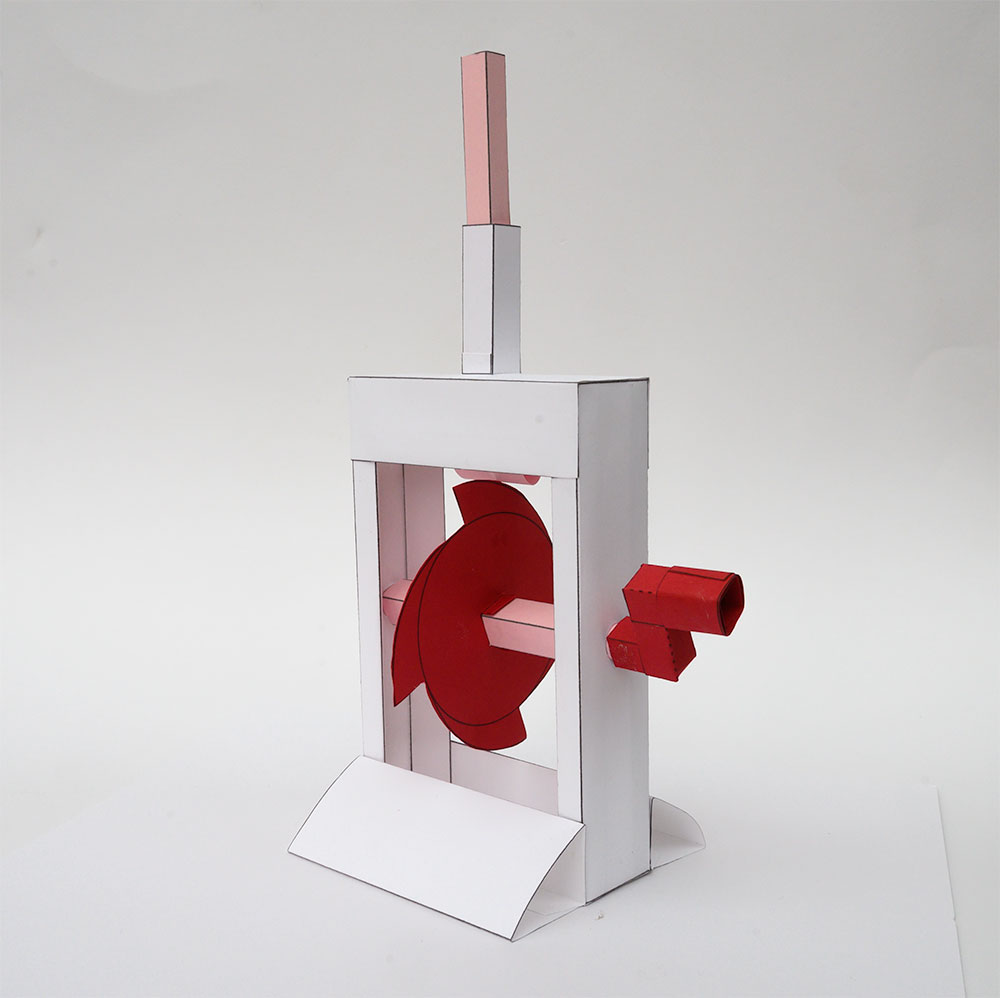
Vertical pendulum, Move the box and the main shaft at the front rocks up and down. This mechanism is destined to be used in the heart of a paper animation, perhaps a hopping frog or a moon walking spaceman. Build the project and bring it alive with your own character!
As usual, members can download the project for free, thanks for signing up. Non-members can download the parts for £2.50
Vertical Pendulum in action.

Print out the first two parts sheets onto thin card (230 micron / 67lb), the third sheet contains hinges, it should be printed onto standard 80gsm printer paper. Paper makes a good flexible hinge.

Glue the two pendulum pieces back to back then glue down the two side flaps.

Glue the paper hinge into place.

Fold the feet round and glue them down. Note that the creases are valley folds.

Glue the two sides to the grey areas on the base. Note that the writing faces towards the longest foot of the base.

Assemble the two struts and glue them into place on the grey areas.

Assemble the top piece and glue it into place using the grey areas for alignment.

Glue the pendulum so that it hands from the front strut.

Assemble the top link as shown. Note that the tongue is completed by folding over the tab and gluing it down to make double thickness card.

Assemble the bell crank as shown. The tongue is the same as the previous link. Glue two paper hinges into place as shown.

You'll need four coins as weights. UK 2p coins are perfect. 25mm in diameter, 7 grams in weight. Wrap each pair of coins tightly in an off-cut of card as shown.

Glue the coin packs to the pendulum front and back.

Glue the bell crank to the lower strut

It needs to be free to rock back and forth.

Connect the upper link to the upper strut with a paper hinge.

Thread the vertical shaft onto the two tongues and lock it into place by gluing the two tabs into place.

Glue the lower link to the front of the coin pack using a paper hinge.

Connect the lower link to the bell crank via the other paper hinge so that the top of the bell crank is sitting horizontally.

There it is! Move the model and the vertical shaft rocks gently up and down. Next step, add your own character!
Keep up to date: Receive the latest blog post by email
Rate this post:

Here's the completed prototype for the vertical pendulum mechanism I'm working on. It's done and ready for photography but that's going to have to wait until morning. To keep you going in the meantime there are a couple of interesting issues that came up in the design/construction of the model.
Two design features: 1) A vertical shaft that moves up and down whenever the project is moved. 2) All wrapped up in a narrow package.
I've folded a bell crank back on itself which seems to work quite well. I'd still rather that the shaft was more central in the mechanism, ideally directly over the pendulum, but it is certainly useable as is.
Okay, first issue. You need a lot of weight to do anything useful. The greater the movement of the vertical shaft, the more weight is needed. This is an issue of maths and physics. The only way round it is to have the pendulum swing further causing other problems elsewhere. (Just had an idea about flywheels though - make a note!)

Second issue it to do with the stability of the model. I have four 2p pieces in the prototype, over 28 grams of your Sterling currency! All that weight tends to bend the card, just slightly, but enough to cause problems. The base flexes slightly causing the model to rock back and forth slowing the pendulum swing and stopping the movement early. (Picture above left) To get round this I've added feet front and back. (Right hand picture above) these provide a solid base for the rest of the model to sit on.

Feet under the base help keep the model steady.
Keep up to date: Receive the latest blog post by email
Rate this post: